Why Stunt Games Feel So Good (and occasionally infuriating)
Now strip it back and two things transform stunt gameshow: physics your brain can predict, and a restart that’s almost instantaneous. Crash, snap back, try again. That speedy loop has you chasing a cleaner line. They ar…
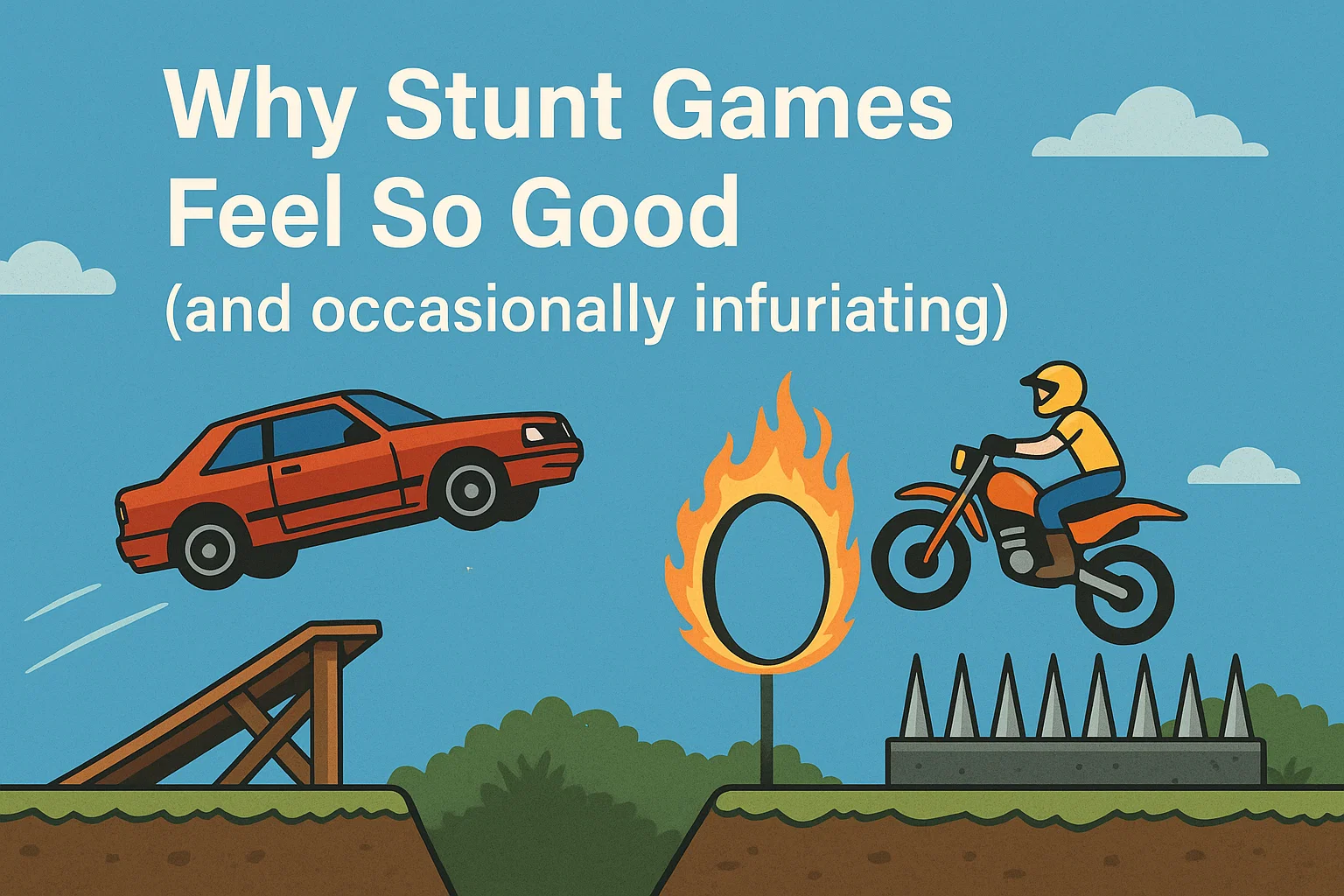
Now strip it back and two things transform stunt gameshow: physics your brain can predict, and a restart that’s almost instantaneous. Crash, snap back, try again. That speedy loop has you chasing a cleaner line. They are the itch that both bikes and cars effectively scratch, but the flavor is different enough that your temperament may determine which one you choose.
Bikes: tightrope energy, flow when it works.
Bikes have light frames, snappy steering and a higher center of gravity, so they reward tiny inputs and punish lazy angles. You thread needles: ramp—>tilt—>micro correction—>wheels down. What’s so appealing, at least to me, is the “I can feel myself getting better” curve; every few minutes the wobble shrinks on its bend and the arcs begin to look less incoherent. The flip side is hard landings — a few degrees off and what feels like a medal run can be over. Recovery room on the kind of compact tracks at the Pan is in rare supply, meaning the best bet a lot of times on where you are going to finish rests more on your line than any heroics.
Cars: swagger, drift and big-air forgiveness
Cars are more forgiving when they have heavier bodies with trapdoor lower centers of gravity. You can wing it —connect a drift, kick from a ramp, land in a bank, slide into the subsequent combo. It’s showier, and frequently more social: open parks beckon you to session a spot and create lines. The downsides are sloppy performance (low FPS, stuttery pacing) that can make steering feel mushy, and the larger maps occasionally leave you on a longer drive back to some feature after you reset.
Which is “faster” (and to and for whom)?
On the flats cars sustain a higher average speed and bikes lap faster on the tech tracks with light mass and rapid rotation. In freestyle, it’s not uncommon for cars to top the scoreboard, since its drift multipliers allow you to tidy up and stack those chains much longer. This probably depends on what you’re after — precision medals, or expressive lines.
Handling to actually master
Bikes
Pitch discipline: Leave takeoff neutral then tap forward/back in air to match landing angle.
Preload pop: A small hop (brake/crouch as applicable) before a jump will provide maximum lift, minimum chaos.
Brake-tap settle: A tiny brake-tap in the air can reduce a nose-dive right before touchdown.
Cars
Weight shift: preload over ramp; get on the gas again to set the chassis.
Intentional counter-steering: Turn into the slide, and steer out to maintain whatever angle you’d like.
Feather it: On slippery trails, 60 to 80 percent throttle can be quicker than full send.
Devices & performance (quick notes)
Controller brings analog finesse to you (also good for both). Keyboard is very much playable - bind lean (on bikes) and handbrake (cars) separately. Keep thumbs near neutral to prevent over-inputs on touch. Smoother 60FPS tends to feel better than jittery 90, close extra tabs and use fullscreen for reduced input lag.
Quick tips to score high
Bikes
Rear-wheel land on uneven ramps and absorb with your balls, then roll the front down.
Tap, not hold: Short inputs balance the car; long presses over-correct.
If the first jump scuffs, that’s all right — 20-second gold runs don’t often survive a bad opener.
Cars
Entry on brake and exit on throttle.
Handbrake to angle, not the whole corner.
Chaining : ramp → bank → drift → hop. Multipliers love mixed tricks.
Common mistakes (and fast fixes)
Bike over-steer: You are waiting too long before starting to lean. Do tap-leans, come back to the center after you make any correction.
Bike nose-dive: You’re muscling forward at the lip. Keep things flat until you clear, then break.
Car drifts and wide plow: Slow down, brake in a straight line and use the head to float.
Car spins after landing: Wheels touched down sideways to the other. Level the car in the air with an itsy-bitsy counter steer.
Fast facts
Session vibe: Bikes (30–90-second loops) vs. Cars (2–5-minute lines).
Learning focus: Bike = micro, control; Cars = line and momentum.
Hardware edge: Controller serves both; keyboard for bike time trials and pad in car freestyle.
Kid-friendliness: Cars are more forgiving; bikes are excellent precision training after you become confident.
FAQ
What makes stunt games “sticky”?
Predictable physics and a near-instant reset. Your brain is in pattern-finding mode, so each failure feels akin to a little lesson rather than punishment.
I’m new to all this — will I start with bikes or cars?
Bike work sprints: If you’ve got five minutes, go try another 5-minute bike sprint and chase a medal. If you can afford twenty, make an open car park, learning to take a drift line and build up longer chains. You probably will also like both, for different moods.
Do I need a controller?
Not required. It does not (analog throttle and steering are nice but …) : This might be useful—there are plenty of top times set on keyboard or touch with good settings.
Both of my runs feel uneven — where to fine-tune first?
One notch lower sensitivity, fullscreen lock and then mean closer pacing of frames. Consistency beats peak FPS. For bikes, practice one track until braking points and ramp angles are muscle memory; for cars, find a corner and loop it until the drift feels like reflex.
How does one quit bailing on landings?
For bikes: off the lip neutral, a little bit back bias on touch up and feathering the throttle. For cars: go flat out, take off just before landing, get back on gently to let wheel down hang.